Peptide Pureness & Quantitation Screening

Inconsistent bit size distribution and morphology can affect bioavailability and security. BOC Sciences is geared up with tools like DLS, TEM, SEM, and so on, to completely analyze nanoparticle dimension, circulation, and microstructure. For us, pureness isn't just a percent-- it's a pledge of stability, uniformity, and regard for the scientific research being done.
What Does Hplc-tested Mean?
" Mass spectrometry solutions "is the identified substance constant with the desired peptide identity? " Together they supply more powerful batch-level evidence than either technique alone. In the common peptide COA context, peak pureness usually describes the percentage of complete chromatogram area stood for by the primary peptide height.
For groups that require deeper structural evaluation, the work can additionally be straightened with peptide sequence evaluation and broader characterization support. Amino acid evaluation or various other quantitative strategies can support absolute content. Chiral techniques can attend to enantiomeric pureness where stereochemistry is a problem. Residual-solvent or water-content examinations can matter in production or stability contexts.Compounds
A useful assay gauging downstream signaling-- or a structural research utilizing NMR or X-ray crystallography-- demands the highest pureness offered. Crystallographers specifically typically need ≥ 98% purity due to the fact that even small contaminants can prevent crystal development or introduce problem into the crystal lattice. As molecules exit the column, they go through a detector-- typically a UV detector readied to 214 or 220 nm, wavelengths where the peptide bond absorbs light highly. The detector documents how much UV light is soaked up over time, creating a chart called a chromatogram. This overview breaks down what pureness actually means in peptide chemistry, just how it's measured, what the impurities are, and just how to read the documents that confirms a peptide is what it claims to be.High purity is desirable since even little Website link contaminants may disrupt speculative outcomes or interpretations. This short article will break down exactly how peptide pureness is determined, why it's distinct from peptide identification, what the common purity degrees (95%, 98%, 99%) indicate, and what "research-grade" suggests in method for peptide reagents. Numerous peptide programs run into analytical unpredictability before they fail scientifically. We use advanced reverse-phase HPLC to figure out the pureness of client peptide examples.
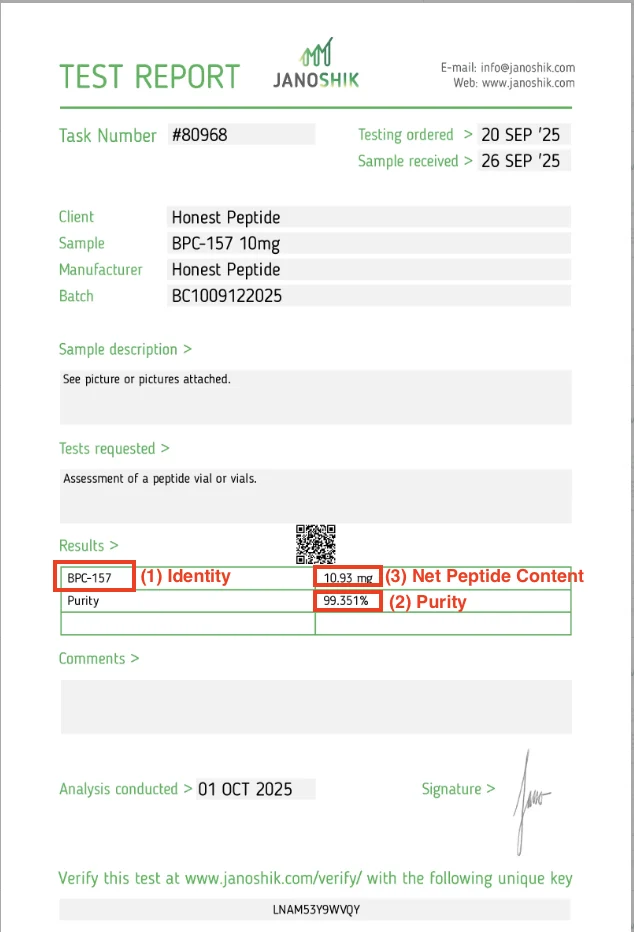
- This grade suits the majority of in vitro study applications-- receptor binding assays, enzyme activity studies, and cell culture experiments.For instance, abbreviated peptides or chemically changed side-products could bind to targets or generate negative effects that confound your results.Trusted peptide providers always mark their products in this manner and supply top quality records with HPLC and MS data to support the pureness degree.We supply HPLC and UPLC purity evaluation process that concentrate on useful splitting up rather than just producing a percent.
The table listed below links common task objectives to useful logical panels and the kind of choices they assist sustain. Asparagine and glutamine deposits can go through deamidation, transforming the peptide's cost and hydrophobicity. Deamidation is one factor storage space conditions matter, specifically after a peptide has actually been reconstituted. Every item we carry is lab-tested and verified by third-party companions, so scientists know specifically what they're dealing with. Peptides containing methionine or cysteine deposits are vulnerable to oxidation. Methionine can be oxidized to methionine sulfoxide; cysteine can develop unwanted disulfide bonds or be oxidized to sulfinic or sulfonic acid by-products.
For many visitors of a peptide beginners' guide, "research-grade" is the realm you run in. It assures you that the peptide will certainly execute well in experiments (presuming pureness and identity are as stated), but it likewise lugs the caution "Research Use Just." This phrase is typically printed on the vial or documents. It serves as a pointer and lawful disclaimer that the item is not a therapeutic or consumable. Relied on labs utilize tested screening procedures to analyze peptide samples and verify their purity and chemical make-up. One core method is High-Performance Liquid Chromatography (HPLC), the gold criterion for examining peptide pureness. HPLC separates peptide mixes and can identify also small impurities listed below 1% of the sample [4] A normal laboratory will certainly run the peptide through an HPLC system and generate a chromatogram-- the major height represents the target peptide, and any type of added optimals suggest other compounds. The pureness is then quantified as the portion of the main top location versus overall areas, offering an exact action of just how pure the peptide is [2]